
You can build a wood patio cover yourself in a weekend or two if you plan it right. The basic process is: check your local permit requirements, design your frame around your actual patio dimensions, set or attach your posts and beams, hang your rafters, add your roof decking or shade material, and seal everything so it lasts. A standard attached lean-to is the most DIY-friendly layout, and that's the build this guide walks you through from start to finish.
How to Build a Wood Patio Cover Step by Step

Celia Vaughn
21 May 2026
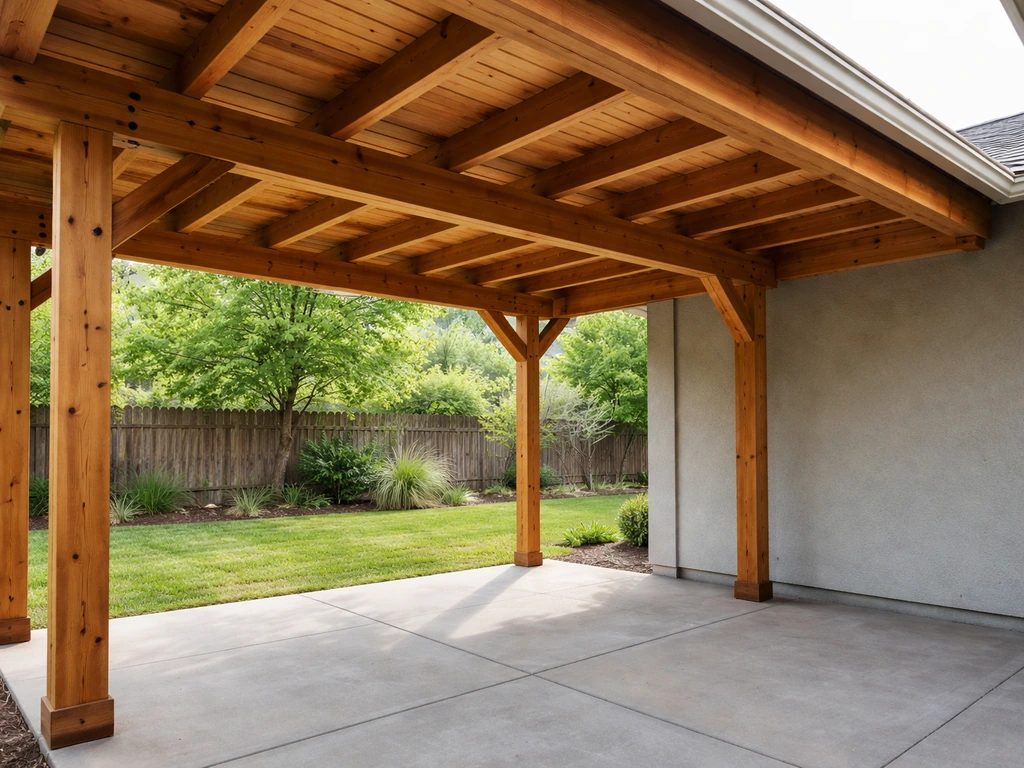
Project planning and checking local requirements

Before you buy a single board, spend an hour understanding what your city or county actually requires. Some jurisdictions provide patio cover guidelines that tie requirements to the International Residential Code (IRC) for accessory or detached structures and require a residential permit application with a detailed description of the work (as reflected in the Annex Texas guidelines) spend an hour understanding what your city or county actually requires. This is the step most DIYers skip, and it's the one that causes the most expensive headaches later. Most jurisdictions treat an attached patio cover as a permitted structure, even though it feels like a simple outdoor project.
Chula Vista, for example, defines a patio cover as a one-story roofed structure not more than 12 feet in height above grade, used only for recreational or outdoor living purposes. That sounds simple, but their rules also note that zoning ordinance requirements can apply even when a building permit isn't required. That means you could legally skip the permit but still violate setback rules and face a complaint or forced removal.
Common local rules you need to check include setbacks from property lines, maximum lot coverage, and maximum height. Riverside, California, for instance, requires that accessory structures over five feet tall be set back at least five feet from side and rear property lines, and that accessory structures cover no more than 35% of required side or rear yard setback area. Queen Creek, Arizona caps rear-yard coverage for accessory structures at 30%. Your numbers will be different, but the categories will be the same.
To find your actual requirements: check your city's building department website first (many now have online permit portals), then call or email the building department directly if anything is unclear. You can also search your address in a permit lookup tool like PermitDeck to see what permits have been pulled on your property before. If your project is in a gray area, asking the building department directly is always better than guessing. And yes, retroactive permitting is possible if you've already started work, but it's more expensive and stressful than doing it right the first time.
Once you know whether a permit is needed, get your site plan sketched out (even a rough hand drawing works for simple permits). Note your patio dimensions, the distance from the house, and the distance to property lines. Many jurisdictions will also want to see your proposed roof pitch, post sizes, and how you plan to attach the structure to the house.
Materials and tools for a wood patio cover
Pressure-treated lumber is your best bet for any framing member that will be close to the ground or exposed to moisture. For posts, use 4x4 minimum for spans up to about 8 feet, and 6x6 for anything taller or wider. Beams are typically doubled 2x8s or doubled 2x10s depending on span. Rafters are usually 2x6 or 2x8 spaced 16 or 24 inches on center. For the ledger (the board that attaches to your house), match the size to your rafters.
If you want a cleaner look and longer life without constant maintenance, consider using cedar or redwood for visible members like rafters and fascia. Both naturally resist rot and insects. Pressure-treated lumber can look rough and may require more prep before staining. Either way, use lumber rated for ground contact (UC4B or better) anywhere your posts will sit in or near concrete.
Lumber and hardware shopping list

- Posts: 4x4 or 6x6 pressure-treated, cut to your desired height plus the depth below grade or post base
- Beam: doubled 2x8 or 2x10 pressure-treated or Douglas fir, length to span between posts
- Ledger: 2x6 or 2x8 pressure-treated, same depth as rafters
- Rafters: 2x6 pressure-treated or cedar, length from ledger to outer beam
- Fascia: 2x6 or 1x6 cedar or redwood for the front face
- Roofing or shade material: corrugated polycarbonate panels, solid decking boards, or shade cloth depending on your goal
- Post bases: galvanized or stainless steel post base hardware (e.g., Simpson Strong-Tie ABA or ABU series)
- Joist hangers: galvanized, sized to your rafter dimension
- Lag screws: 3/8-inch diameter by 5-inch length for ledger attachment (one common standard), with washers
- Structural screws or through-bolts for beam-to-post connections
- Exterior wood screws, 3-inch and 1.5-inch for general assembly
- Post caps for connecting beams to posts (Simpson LCE or similar)
Tools you'll need
- Circular saw or miter saw for cutting lumber to length
- Drill/driver with a long 3/8-inch bit for lag screws
- Impact driver for driving structural screws
- Level (4-foot and 2-foot)
- Speed square for checking rafter angles
- Chalk line for layout
- Tape measure
- Post hole digger or rented power auger if setting posts in concrete
- String line and stakes for layout
- Safety glasses, hearing protection, and work gloves
- Ladder or scaffolding for working at height
Design and sizing basics
Most residential attached patio covers fall somewhere between 10 feet wide and 20 feet wide, and 8 to 16 feet deep (out from the house). For a basic lean-to, your ledger attaches to the house at the high end, and your outer beam sits on posts at the low end. Pitch matters: you need enough slope to shed water. A minimum slope of 1/4 inch per foot is workable for solid roofing panels, but 1/2 inch per foot is better for wood decking. For a 12-foot-deep cover, that means your ledger sits about 3 to 6 inches higher than the outer beam.
Rafter spacing is usually 16 or 24 inches on center. Tighter spacing (16 inches) is stronger and better for heavier roof loads or wider spans. If you're doing an open pergola-style cover with decorative rafter tails hanging past the beam, 24-inch spacing still looks great and saves material. Roof live load for patio covers in many California jurisdictions is listed at 10 psf (pounds per square foot), which is lower than a full residential roof, but you still need to size your lumber to handle it.
A quick rule of thumb for rafter sizing: 2x6 rafters at 24-inch spacing can span roughly up to 12 feet. For spans up to 16 feet, step up to 2x8. For beams, doubled 2x10s can span about 10 to 12 feet between posts. If your patio is wider than that, add a center post. When in doubt, go up a size. Lumber is cheap; callbacks and repairs are not.
| Span (Rafter Length) | Rafter Size | Spacing | Notes |
|---|---|---|---|
| Up to 10 ft | 2x6 | 24" OC | Works for open shade structures |
| Up to 12 ft | 2x6 | 16" OC or 2x8 at 24" | Better for solid roofing materials |
| 12–16 ft | 2x8 | 16" or 24" OC | Check local span tables for your lumber species |
| Over 16 ft | 2x10 or engineered | 16" OC | May require engineering review |
Post height depends on where you want your finished ceiling line. Most people target 8 to 9 feet at the low end (outer beam). Remember that your ledger will sit several inches higher than the beam to create slope, so account for that in your layout. Keep the structure under 12 feet at its highest point if you want to stay within the most common patio cover definitions used by local codes.
Step-by-step build process: layout to framing
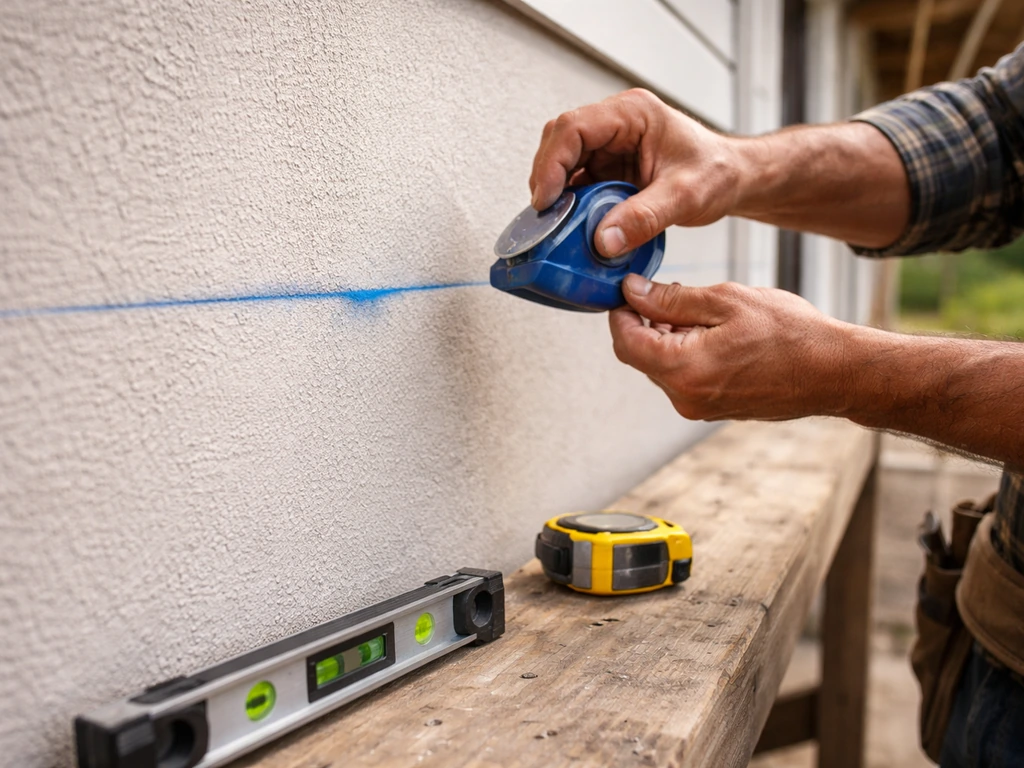
- Mark your layout on the house wall. Snap a chalk line at the height where the top of your ledger will sit. Double-check this against your slope calculation: measure out the full depth of your cover and confirm the outer beam height will land where you want it.
- Locate the house studs or rim joist. Your ledger bolts into solid framing, not just sheathing. Use a stud finder and mark every stud in the ledger run. If you're attaching to a rim joist, verify its thickness and condition before committing to this attachment point.
- Remove siding behind the ledger zone. Cut back the siding so the ledger sits against the house sheathing or framing directly. This lets you properly flash the ledger later. Do not skip this step or water will get behind the ledger over time.
- Cut and position your ledger board. Set it at your marked height, drill pilot holes, and fasten with 3/8-inch by 5-inch lag screws into every stud, spaced no more than 16 inches on center. Use washers under each lag head. Two lags per stud location (staggered high and low) creates a stronger connection.
- Set your post locations. Use string lines and a square to mark exactly where each post will land. For an attached cover, you typically have one line of posts at the outer edge. Measure diagonally corner to corner to verify your layout is square before digging.
- Install post bases or dig post holes. Post bases set in concrete are cleaner and adjustable; they keep the wood off the ground and resist rot. If you're setting posts directly in concrete, use ground-contact rated lumber and pack the hole well. Most codes require holes at least 18 inches deep and below your local frost line.
- Set and brace your posts. Get each post perfectly plumb in both directions before the concrete sets (if footing type) or before final fastening. Use temporary diagonal braces screwed to stakes in the ground. Do not move on until every post is plumb.
- Install the outer beam. Lift the beam onto the post tops (get a helper here) and secure it with post caps. If using doubled lumber, nail or screw the two pieces together before lifting. The beam should be level along its length.
- Cut and install your rafters. Mark your rafter layout on both the ledger and the beam at consistent spacing. Cut a bird's mouth notch at the beam end if needed for a flush seat (optional but cleaner). Hang rafters on the ledger using joist hangers and toenail or use a rafter tie at the beam end. Every rafter needs both ends secured.
- Add blocking at the ledger and at the outer beam between rafters. Blocking stiffens the frame, prevents rafter rotation, and closes off the ends so pests can't nest inside the structure.
Common mistake at this stage: not checking for plumb and level at every step before moving to the next one. A post that's 1/4 inch out of plumb multiplies into a beam that's off, which means crooked rafters and a roof that doesn't drain properly. Measure twice, plumb and level before fastening, and fix problems while they're still easy.
Roofing, decking, waterproofing, and drainage
Your roofing choice determines how watertight the cover is and how much maintenance it needs. If you want to keep water out and avoid common leaks, focus next on roofing, decking, waterproofing, and drainage details. The three most common options for DIY wood patio covers are solid wood decking with roofing material on top, polycarbonate or corrugated panels, and open spacing with shade cloth or no covering at all.
Solid roof deck with shingles or roll roofing
For a fully weather-tight cover, sheath the rafters with 1/2-inch or 5/8-inch plywood or OSB. Apply a layer of 30-lb felt paper or synthetic underlayment overlapped at least 6 inches. Then finish with asphalt shingles, metal roofing panels, or rolled roofing. This gives you the most protection from rain but also adds the most weight to your frame (be sure your rafter sizing accounts for it) and requires the most flashing work where the roof meets the house wall.
Polycarbonate or corrugated panels
Corrugated polycarbonate panels are popular because they're lightweight, translucent (letting in diffused light), and easy to cut with a circular saw or jigsaw. You fasten them with special closure strips and roofing screws with neoprene washers. Overlap panels by one corrugation and seal the ridge end. These panels need to run parallel to the rafters, so plan your layout accordingly. Clear panels show dirt and algae over time; tinted versions hide this better.
Open or partially open shade structures
If shade is more important than waterproofing, you can space your decking boards with gaps (like a classic pergola) or use shade cloth stretched between the rafters. This dramatically reduces the weight and complexity of the build and looks great, but you won't be protected from rain. Many people go this route first and add solid roofing later.
Flashing and drainage details that actually matter
Where your roof surface meets the house wall is the most common leak point on any patio cover. Install Z-flashing (step flashing or continuous Z-flashing) behind the siding and over the top edge of the ledger or the edge of the roof deck. The flashing should tuck behind the siding above and lap over the roofing surface below by at least 2 inches. Do not rely on caulk alone. Caulk fails; flashing doesn't (if installed correctly). Also make sure your slope drains away from the house, not toward it. Even a very slight reverse pitch can dump water against your foundation over years.
Ledger attachment and structural safety

The ledger connection is the most structurally critical part of an attached patio cover. It carries the load of every rafter back into the house, and it also has to resist uplift forces in high wind. Getting this right is not optional.
San Diego's building department publishes a specific detail: the ledger should be the same size as the rafters it supports, fastened into studs with 3/8-inch by 5-inch lag screws at a maximum of 16 inches on center. That's a solid benchmark even if you're building in a different jurisdiction. Two lags per stud location (one high, one low) is even better for resisting rotation. Always drill pilot holes to prevent splitting, and always use washers.
What often goes wrong here: people attach the ledger to stucco or siding without reaching the actual framing, or they attach to a fascia board instead of the structural rim joist. Both situations can result in the ledger pulling away from the house under load, which is a serious safety hazard. If you're not sure what you're attaching to, open the wall or consult a contractor before proceeding.
For the outer beam-to-post connections, use rated post caps (like Simpson Strong-Tie LPC or ABA series) rather than toenailing alone. These hardware pieces are engineered to resist both vertical load and lateral (sideways) forces. Similarly, use joist hangers for every rafter-to-ledger connection rather than just toenailing. These connections are cheap and they're what keep your structure together in a storm.
If your patio cover is freestanding rather than attached to the house, the beam-and-post system carries all the load, and you need diagonal bracing in at least one direction to prevent racking. If you're planning a freestanding patio cover, make sure you address post sizing, beam spans, and diagonal bracing so the structure can resist racking. Cross-bracing between posts or knee braces from post to beam are common solutions. A freestanding build has different design considerations worth looking into separately.
Finishing, sealing, maintenance, and when to stop and call a pro
Finishing and sealing the wood
Unfinished wood left outside will gray, crack, and eventually rot no matter how good the lumber is. Before your cover goes into service, apply a penetrating exterior sealer or a solid-color stain with a built-in sealer to all exposed wood surfaces. For pressure-treated lumber, let it dry for at least 30 days after installation before applying stain or sealer so the preservative treatments can stabilize. Cedar and redwood can be sealed sooner. Pay extra attention to end cuts, which absorb moisture fastest. Brush end-cut sealer onto every cut end before assembly when possible.
For hardware, use hot-dipped galvanized or stainless steel everywhere. Electroplated zinc hardware (the cheap shiny stuff) will rust within a couple of seasons in most climates and can stain your wood with rust streaks. Check that your joist hangers and post bases are rated for use with pressure-treated lumber, since the preservative chemicals can corrode standard galvanized hardware over time.
Ongoing maintenance schedule
- Every year: inspect flashing at the house connection and caulk any gaps; check for soft spots in the wood that could indicate moisture intrusion
- Every 2 to 3 years: reapply penetrating sealer or re-stain if the finish is showing wear, peeling, or graying
- Every year: clear debris from the roof surface and gutters (if any); debris traps moisture and accelerates rot
- Every 2 to 3 years: tighten any visible fasteners that may have worked loose with seasonal wood movement
- After major storms: inspect the ledger connection, beam-to-post hardware, and roof surface for damage
When to hire a professional or an engineer
Most standard DIY wood patio covers don't require an engineer if you stay within normal dimensions and use published span tables. But there are situations where hiring a structural engineer or licensed contractor is the right call, and it's worth being honest about them.
- Your jurisdiction requires a stamped engineering plan as part of the permit (some cities do for any attached structure)
- Your house has an unusual wall construction (e.g., ICF, SIPs, steel framing) that makes ledger attachment non-standard
- Your patio cover will be large (over 400 square feet), unusually tall, or in a high-wind or high-snow-load zone
- You find rot, damage, or unknown conditions in the wall framing when you open up the attachment area
- You're attaching to a second-story wall or above a living space where a structural mistake would have serious consequences
- You've already built without a permit and need to go through retroactive permitting, which often requires a current inspection and possibly engineering documentation
An engineer consultation for a simple patio cover typically costs $300 to $700 and is worth every dollar if your situation is complicated. Don't let the cost talk you out of it when the stakes are high.
Final verification checklist before calling it done
- Ledger is bolted to structural framing (studs or rim joist), not just sheathing or siding
- All lag screws are fully seated with washers, no splits in the ledger board
- Every post is plumb in both directions and properly secured at the base
- Beam is level and connected to posts with rated post caps
- Every rafter is connected at both ends with joist hangers or rated hardware
- Roof slope runs away from the house, not toward it
- Flashing is installed behind siding and over the roof edge at the house connection
- All exposed wood is sealed or stained, including end cuts
- All hardware is hot-dipped galvanized or stainless steel rated for pressure-treated lumber
- If a permit was required, your inspection has been signed off
If you can check every box on that list, you've built a wood patio cover that will last 20 to 30 years with basic maintenance. The planning and framing stages take the most time and attention, but get those right and the rest of the build comes together quickly. For variations on this layout, including fully freestanding builds, gable-roof designs, or lean-to structures with a steeper pitch, the framing principles are the same, just scaled to the different geometry.
If you want to focus specifically on the deck-framing piece, the same planning and sizing logic will help you learn how to frame a patio deck step by step. This guide covers the typical steps for how to build a lean-to patio cover, from planning to framing and roofing.
FAQ
How do I tell what size patio cover I can build without redesigning everything?
Start with the ledger location and the roof slope you need, then work outward. If you change the cover depth, the beam height and rafter run change, which affects span, rafter size, and sometimes post spacing. Use your planned slope first (how many inches higher the ledger will be at the house), then confirm the rafter span and whether you need an extra post before you order material.
Can I build a wood patio cover directly on the existing patio slab or pavers?
Usually not. Posts need a stable foundation line and correct footing size, often below frost depth depending on your area. Pouring directly into paver bases or using surface blocks can shift, which breaks plumb and causes long-term drainage problems. If your slab already exists, you still may need core drilling and proper anchor bolts or a new footing solution.
What’s the best way to keep water from rotting the ledger and the area where it meets the house?
Treat the ledger as the waterproofing priority. Ensure the house connection uses proper flashing installed behind siding, with a clear water path down and away from the structure. Also add drip edge details at the roof edges so runoff doesn’t soak into the fascia or run behind trim where it cannot dry.
If my city says a permit might not be required, can I skip it to avoid paperwork?
Not always. Some jurisdictions waive permits for certain dimensions, but still enforce zoning limits like setbacks and lot coverage. That means you could still be out of compliance even if no permit is issued. If you cannot confirm in writing, ask how setbacks are measured for attached covers and whether the cover is treated as an accessory structure.
How far apart should rafters be if I want a stronger roof for snow or heavier loads?
Don’t rely only on the default spacing. If you expect higher roof loads, use tighter spacing (for example, move from 24 inches on center to 16 inches) and step up lumber size where spans demand it. Also include the weight of your roofing system, like plywood and shingles, because that load can change the sizing more than people expect.
Can I use standard nails or screws everywhere instead of the recommended hardware?
For critical structural connections, no. Replace toenailing-only methods with rated post caps and use joist hangers for rafter-to-ledger connections, because the hardware is designed for both vertical load and lateral forces. Use the correct fastener type and length, and always drill pilot holes where the build instructions call for it to reduce splitting.
What should I do if I have a slight slope issue, my pitch is low, or the roof seems to drain toward the house?
Correct it before roofing goes on. Reverse pitch often comes from a post that is not truly plumb, or ledger height that was set without checking the run. Relevel or reset the posts and beams, then recheck the underside clearance and rafter alignment. Once panels and flashing are installed, fixing slope is far more expensive.
How do I prevent algae stains on clear polycarbonate panels?
Plan for easier cleaning and use either tinted panels or a cleaning routine early. Clear panels tend to trap moisture against the surface, so dirt and algae build faster. Make sure your overlap and sealing are correct, because small leaks can leave persistent wet streaks even after everything else dries.
Can I seal or stain everything right away after building, or do I need to wait?
Wait for pressure-treated lumber to stabilize, commonly at least 30 days after installation before applying stain or sealer, especially if it was recently installed in damp conditions. Also seal end cuts immediately because those areas absorb moisture fastest. If you used cedar or redwood, they can often be sealed sooner, but check product label timing for best results.
What’s the most common attachment mistake that causes structural failure in attached patio covers?
Attaching the ledger to non-structural trim, siding, or stucco rather than reaching real framing members. The ledger must transfer load into studs and underlying structural elements, not just into decorative surfaces. If you cannot locate studs and the structural rim joist, open the wall or verify from original framing plans before fastening.
Do I need diagonal bracing even if my patio cover is attached to the house?
Often less bracing is needed for attached designs because the house provides stability, but you still need to think about lateral forces like wind. If your design has longer freestanding spans, wider covers, or posts with larger height, add bracing to prevent racking. When in doubt, verify with local guidance or a contractor, especially for tall covers and high-wind areas.
How do I choose between solid roofing, panels, and an open pergola style?
Choose based on your goal for rain protection and maintenance first. Solid systems are the most watertight but require heavier framing, better flashing, and careful load sizing. Panel roofs are lighter and allow diffused light, but you need correct overlap and sealed fastener details. Open decking or shade cloth reduces weight and cost, but it is not a weatherproof solution, so plan for water management during storms.